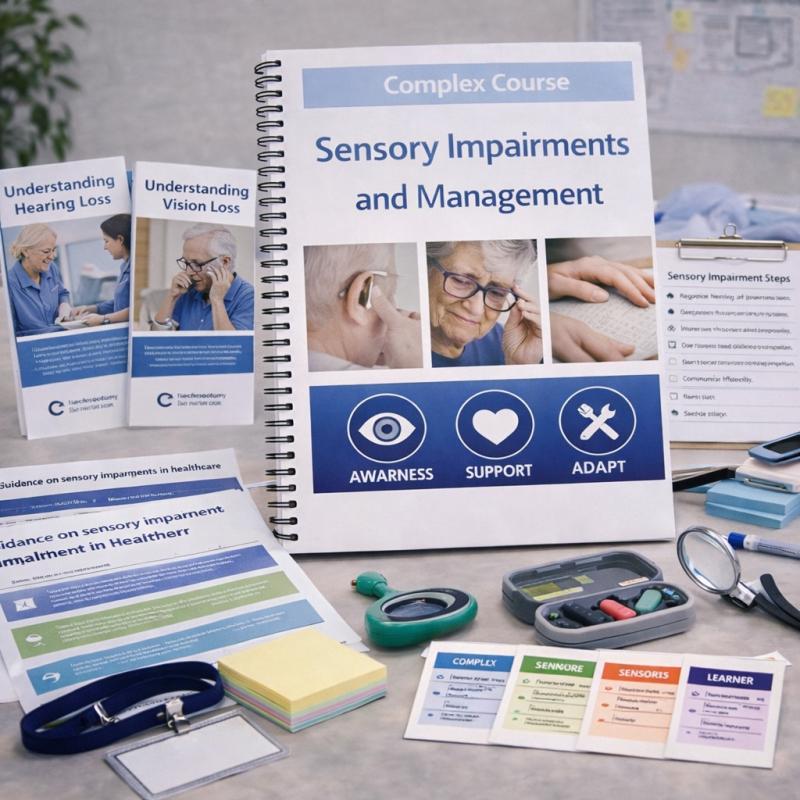
This advanced course provides in-depth knowledge and practical strategies for supporting individuals with sensory impairments, enabling professionals to deliver safe, person-centred care while promoting independence, communication, and wellbeing.
Understand the different types of sensory impairments, including visual, hearing, and dual sensory loss.
Recognise the causes, signs, and impact of sensory impairments on individuals’ daily lives.
Develop skills to communicate effectively with individuals with hearing or visual impairments.
Learn how to adapt care environments to improve accessibility and safety.
Understand the use of assistive technologies and support aids (e.g. hearing aids, visual aids, communication tools).
Gain knowledge of person-centred approaches to support independence and dignity.
Understand the impact of sensory loss on mental health, behaviour, and social interaction.
Learn how to assess risks and implement appropriate care plans for individuals with sensory impairments.
Develop strategies to support individuals with dual sensory impairment (deafblindness).
Understand the importance of multi-disciplinary working and specialist referrals.
This course is suitable for healthcare professionals, senior carers, support workers, and managers working with individuals who have sensory impairments in residential, community, or clinical settings.
Duration: 1/2 Day
Mode: In-person training only
Assessment: Case studies, practical scenarios, and written assessment
Participants will receive a Sensory Impairments and Management Certificate upon successful completion of the course.
The certification is valid for 2 years (in line with organisational requirements).
Equality Act 2010
Care Act 2014
Health and Social Care Act 2008
Human Rights Act 1998
Accessible Information Standard (NHS)
Mental Capacity Act (MCA) 2005
There are currently no upcoming courses
