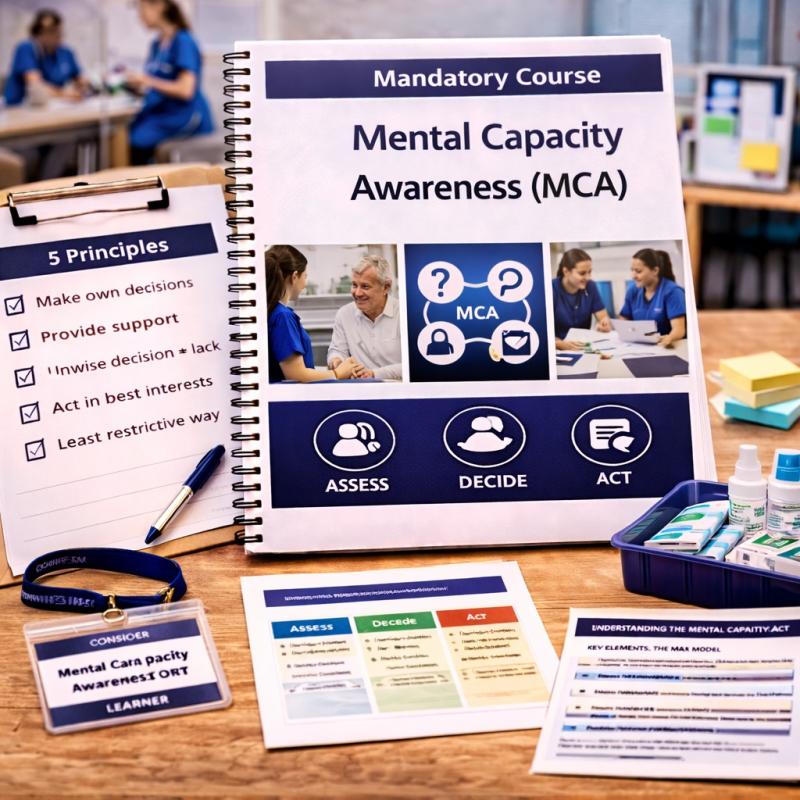
This course provides essential knowledge of the Mental Capacity Act (2005), enabling staff to support individuals in making informed decisions while protecting their rights, dignity, and independence.
Understand the principles and purpose of the Mental Capacity Act (MCA) 2005.
Learn the 5 key principles of the MCA and how they apply in practice.
Develop the ability to assess mental capacity in line with legal requirements.
Understand the concept of best interests decision-making.
Learn about consent, autonomy, and the right to make unwise decisions.
Gain knowledge of Deprivation of Liberty Safeguards (DoLS) and when they apply.
Understand the role of Lasting Power of Attorney (LPA) and Court of Protection.
Learn how to record capacity assessments and decisions appropriately.
Develop awareness of safeguarding implications linked to capacity and consent.
Understand professional responsibilities and legal accountability when supporting individuals lacking capacity.
This course is suitable for healthcare professionals, support workers, carers, and managers working with individuals who may lack capacity in healthcare, residential, or community care settings.
Duration: 1/2 Day
Mode: In-person training only
Assessment: Case studies, practical scenarios, and written assessment
Participants will receive a Mental Capacity Awareness (MCA) Certificate upon successful completion of the course.
The certification is valid for 1–2 years (in line with organisational policy).
Mental Capacity Act (MCA) 2005
Deprivation of Liberty Safeguards (DoLS)
Liberty Protection Safeguards (LPS) (where applicable)
Care Act 2014
Human Rights Act 1998
Health and Social Care Act 2008
Data Protection Act 2018 (GDPR)
There are currently no upcoming courses
